
Have you ever wondered why people come up with
the same or similar ideas independently at the same time? One can suppose that
there is a foundation of knowledge or events that predispose people working in
a similar area to reach similar conclusions. Arguments as to who came up with
an idea first, such as that between Charles Darwin and Alfred Russel Wallace in
respect of the natural selection of species, are all too common. It is almost
inevitable that once someone has made a discovery, or had an original idea,
someone else will have the same or a very similar idea at the same time.
 Rupert
Sheldrake
Rupert
Sheldrake discusses this
phenomenon in terms of morphic resonance, the idea that the ‘laws of nature’
are a habit, and evolution a process involving ‘morphic fields’ that hold and
transmit memory from the past to the present. Twin studies are used as another
example of connectivity to a field or grid. Sheldrake argues that they have
failed to explain similarities and mutual sensibility in terms of memory traces
inside the brain.
The idea of morphic
resonance enables the brain to be seen as more like a TV reciever than a
recording system. Memories are not stored in the brain: the brain tunes into
them (2011:6). This notion of a ‘field’ is more closely related to string
theory and entanglement than to Newtonian physics. A further example sometimes
quoted is that of the gregarious
blue tit learning to pierce the aluminium tops of milk
bottles in the early 1950s. While this can be seen as an example of evolution
in process, there is also a suggestion that once blue tits in one area had
learnt the trick, those in another area learnt it more quickly. Imitation alone
could not explain the speed at which this ability spread throughout the blue
tit population. Once someone has had an idea, or practiced a skill, it seems to
be easier for others, even distant and unconnected others, to do the same. This
is a contraversial idea, and while backed up by anecdotal evidence is could be
tested using conventional scientific methods.
Perhaps harder to test
scientifically is the assertion from those who claim to transmit information
from the astral planes that creativity and thought are very closely linked. The
phenomenon of simultaneous discovery and rapid learning at a distance can be
explained by the creation of thought forms that take shape in the astral or
mental planes (which make up part of the being of all humans, along with the
energetic or etheric and physical/material planes), which are then are picked
up by those who are receptive to them. People on the material plane may receive
an idea or impression in a dream, as a sudden inspiration, or seemingly from
some higher part of themselves (imagination, muse, creative impulse). Typical
of such discoveries or ideas is that they give the impression of arriving fully
formed, almost independent of the recipient, or as the result of a ‘request’ to
a higher power.

Bruce Moen, using a form of ‘tuneing in’ to
different vibrational frequences through manipulation of brain waves, a
technique developed and taught by
The
Monroe Institute,
describes this creative process in some detail. He leans that everything
capable of conscious awareness is connected to a Grid, and that there exists
what he calls a Planning Centre with conduits of awareness connecting
inventions/ideas/prototypes deposited there with people on earth who are receptive,
or who are looking for a solution to a problem. One of the easiest ways to
transferr the idea to the physical world is via a dream, but it still has to be
made conscious, perhaps through the use of memory triggers. The person looking
for something might see it themselves while asleep and travelling in their
astral body, and be reminded of it by particular events when conscious. The
reason so many inventors come up with the same thing at the same time becomes
apparent. As Moen’s guide explained,
For
critical inventions we arrange cross-over points to transmit the idea to as
many people in physical reality as we can find who have the capacity to receive
it and to be a part of bringing it through’ (1999:115).
 |
| Judge Hatch (1846-1912) |
The Honorable Judge David Patteson Hatch, writing through the hand of medium Elsa Barker shortly after his
arrival on the astral plane, is one of many such communicators to describe the
power of thought. Whether he had been aware of Theosophist writings on
Thought-Forms published in the early Twentieth Century I don’t know, but his
post-mortem view is certainly very similar to that expressed by other explorers
of this esoteric world, both then and now. Imagination
has great power. If you make a picture in your mind, the vibrations of the body
may adjust to it if the will is directed that way, as in thoughts of health or
sickness he advises (Barker 2004:24-5). In the astral world both movement
and physical creation are through thought, although people often choose to walk
from one place to another, and to speak rather than communicate telepathically,
at least for a while, out of habit. Judge Hatch decided that he wanted to wear
a toga rather than the clothes he arrived in, and was shown by his Teacher how
to, create garments such as I desired: To
fix the pattern and shape clearly in my mind, to vizualize it, and then by
power of desire to draw the subtle matter of the thought-world round the
pattern, so as actually to form the garment (p.43). He also discovered that
some objects have considerably more solidity and tenacity than others,
depending it seems upon the skill of the creator, the matter from which they
are constructed and the intention of the creator or creators. The inhabitants
of the astral plane (or earth bound travellers such as Moen) learn to create
houses, scenery and other objects that can either endure after they have moved
on for others to enjoy, or be dissolved at will.
The astral plane on which Judge
Hatch found himself was, he was sure, a place in space. Like other such communicators he understood
the astral planes as a sphere surrounding the earth, interpenetrating it but of
a finer vibrational frequency. When one sleeps one can come out into this finer
world of the mind and imagination and see
things that exist, or have existed, in the material world also (p.24). The
lower planes appear to contain replicas of everything that exists on earth, or
rather vice versa as it is the astral world that appears the more real and solid,
and which precedes the material. On finer strata is the world of patterns (the
Focus Level 15 described by Moen, on which he discovered the Planning Centre), the paradigms - if that is the word - of
things which are to be on earth
(p.31). Judge Hatch found here future inventions – in advance of what exists on
earth, but as we can see with the advantage of time, not so far in advance as
to be of no use to those on earth. Gradual discovery and development evidently
continues on the astral planes much as it does on the material level: I saw forms of things which, so far as I
know, have not existed on your planet – inventions, for example. I saw wings
that man could adjust to himself. I saw also new forms of flying-machines. I
saw model cities, and towers with strange winglike projections on them, of which
I could not imagine the use. The progress of mechanical invention is evidently
only begun (p.31).
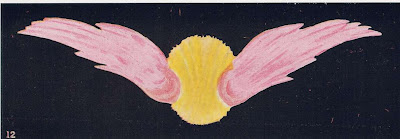 |
| Wings of Love (peace and protection) Besant and Leadbeater 1925 |
A final thought on thought: There
was a discussion on BBC Radio 4's 'Word of Mouth' on 30th April on
the process of simultaneous interpretation. One interpreter commented on how
much easier it was to follow an extemporaneous talk than a prepared lecture. In
the former case she could pick up the thoughts as they were forming in the
speaker's mind, whereas with a written text, orally delivered, the thinking had
already been done, and it was therefore harder to pick up the thoughts of the
speaker. It was not a matter of the language or register but of the immediacy
of the thought. To Theosophist writers Annie Besant and Charles Leadbeater this
would have been self evident, as they were well aware of the materiality of
thought and its transmission and reception. It is a consistent message that
what we think is not a private matter, it communicates to those around us
whether we are aware of it or not. Interesting!
(I accidentally
erased this version, rewrote it with slightly different material and then
managed to recover the older version. The joys of computers!).
References
There are numerous accounts
of post-mortem adventures communicated telepathically, or by other means, such as automatic writing, to
those still living on earth, from the earliest historical records to the
present. Their message is perhaps surprisingly consistent – allowing for the
fact that differences are often accounted for by the fact that each one
inhabits a different sphere according to their level of development, and that
the power of thought and expectation enables people, at least initially, to
create the afterlife world they expect to find on passing over. Judge Hatch’s experiences are
taken from Elsa Barker, Letters from the Afterlife:
A Guide to the Other Side, (Beyond Words: Hillsboro, Oregon, 2004.
Originally published as Letters from a
Living Dead Man, Rider, 1914).
The idea of thought having
a physical form, visible in the astral world and to clairvoyants on earth, is
often found in channelled and esoteric literature. One of the most succinct
expressions of this idea is by the Theosophist writers Annie Besant and C.W.
Leadbeater, in Thought-Forms (with
colour and black and white illustrations). (A Quest Book, Theosophical Publishing
House: Wheaton, Ill., Madras, London, 1980. Originally published in Adyar,
1925).
Bruce Moen was deeply
influenced by the pioneer of conscious astral exploration, Robert Monroe. He
has published a series of books on his travels to different
zones or planes of consciousness in his Exploring the Afterlife Series. The
passage referred to is from Vol. 3, Voyages
into the Afterlife: Charting Unknown Territory (Hampton Roads:
Charlottesville, Virginia, 1999).
Descriptions of morphic
resonance and possible explanations for the phenomenon are given in Rupert
Sheldrake, The Presence of the Past: Morphic Resonance and the Habits of
Nature (Icon Books: London, 2011) as well as elsewhere in
Sheldrake's work.
 This discussion was recorded at the BASR (British Association for the Study of Religion) conference at Milton Keynes in September 2014 for the Religious Studies Project.


